The Hidden Engineering Behind Enterprise AI
Enterprise AI isn't defined by the model you choose. It's defined by the engineering that keeps it reliable, scalable, and secure in production.
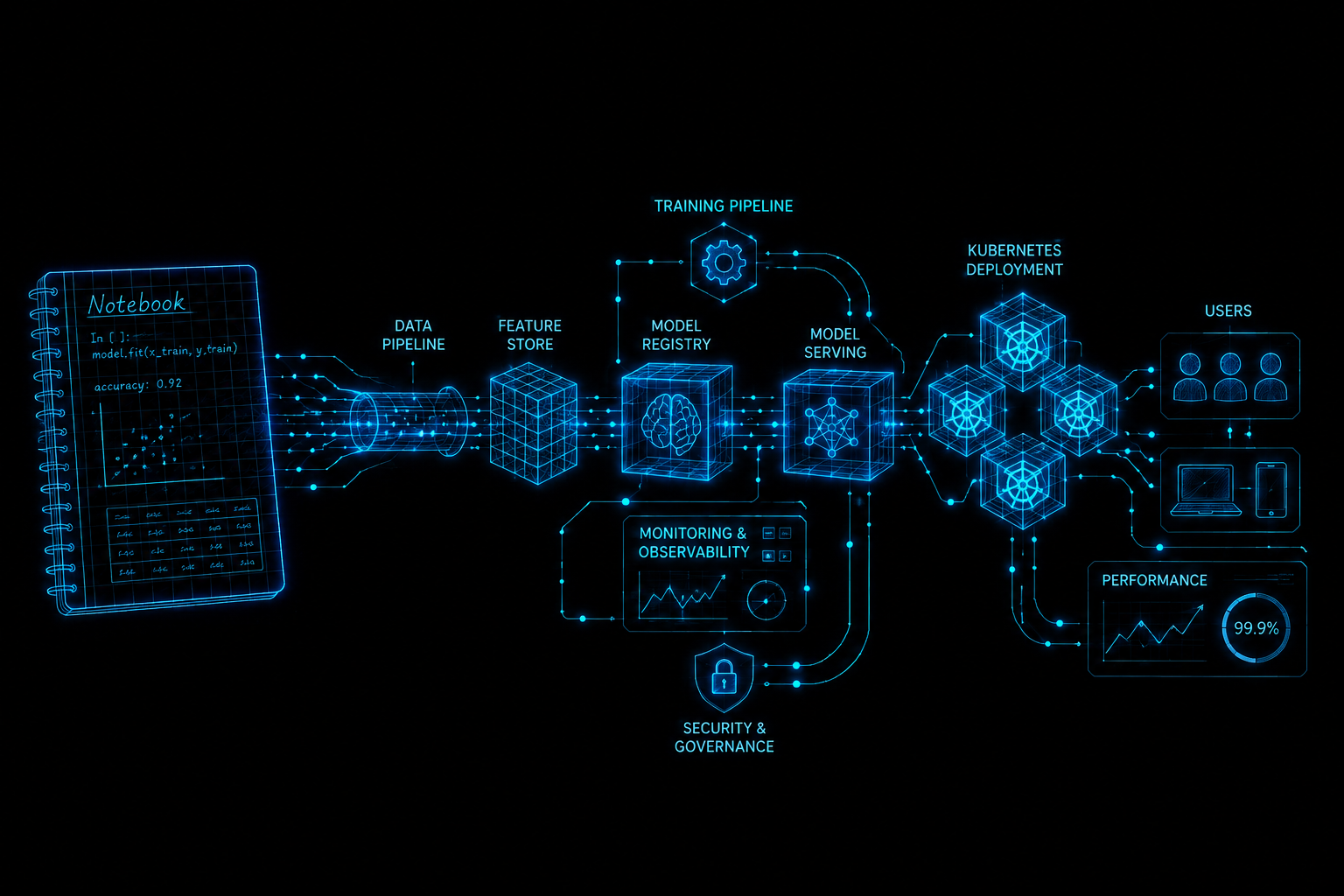
Most enterprise AI conversations begin with models.
The successful implementations begin with engineering.
While foundation models continue to improve, the biggest challenge for enterprises isn't selecting the right LLM—it's building the systems that allow AI to operate reliably, securely, and at scale.
The Invisible Complexity
An AI response might take only a few seconds to generate, but those seconds depend on a much larger engineering ecosystem.
Enterprise data needs to be collected, cleaned, transformed, indexed, secured, and made retrievable. Infrastructure must scale with demand. Systems need monitoring, observability, security controls, and deployment pipelines that can evolve without disrupting business operations.
Without these foundations, even the most capable model becomes another impressive demo that struggles in production.
What Enterprise AI Actually Requires
Production-ready AI systems are built on more than models. They rely on engineering disciplines such as:
- High-throughput data pipelines that keep information fresh and reliable
- Retrieval systems that connect AI with enterprise knowledge
- Cloud-native infrastructure designed for scalability and resilience
- MLOps pipelines for repeatable deployments and continuous improvement
- Observability and monitoring to detect issues before users do
- Security and governance that protect enterprise data
These components are rarely visible to end users, but they determine whether AI creates lasting business value.
The Ingelenz Approach
At Ingelenz, we engineer the systems behind enterprise AI—not just the models.
From production-grade MLOps and scalable data pipelines to enterprise search, natural language analytics, and cloud-native infrastructure, our focus is on building AI solutions that remain reliable long after deployment.
Because enterprise AI isn't measured by how well the demo performs.
It's measured by how well the system performs when the demo is over.